
Table of Contents
- Why Leadership in College Essays Matters
- What Counts as Leadership Redefining College Application Leadership
- Demonstrating Leadership in Applications The Dos and Donts
- Analysis of Successful Common App Leadership Essays
- Selecting and Showcasing Leadership Extracurriculars for College Admissions
- What Admissions Officers Really Look For in Leadership Essays
- Common Pitfalls in Writing About Leadership
- Resources and Next Steps
- Conclusion Key Takeaways for Leadership in College Essays
Why Leadership in College Essays Matters
Leadership in college essays matters more than most students realize. It's not just about listing positions or titles—it's about demonstrating how you've made an impact, taken initiative, and grown through experiences that have shaped your character. Colleges consistently rank leadership qualities among their top criteria when evaluating applicants, making it essential to effectively showcase these experiences in your application essays.
When admissions officers review thousands of applications, they're looking for students who will contribute meaningfully to their campus communities. Leadership in college essays provides concrete evidence that you're not just academically capable but also personally driven to create positive change.
According to the College Board, "Colleges want to see that you've shown leadership qualities... whether it was in student government, sports, volunteer work, or in other activities." This emphasis on leadership isn't arbitrary—it reflects colleges' desire to build communities of engaged, proactive students who will thrive in collaborative academic environments.
Many application prompts directly invite students to showcase leadership experiences. The Common Application, used by over 900 colleges, includes prompts like "Describe a time when you made a meaningful contribution to others" and "Reflect on a time when you questioned or challenged a belief or idea." These prompts create natural opportunities to demonstrate leadership in college essays.
If you want more advice on how to craft a standout personal statement, see How to Write a Successful College Essay That Stands Out for expert strategies and example essays.
This guide will help you strategically express your leadership experiences with concrete examples, authentic storytelling, and evidence-based approaches that admissions officers find compelling.
What Counts as Leadership Redefining College Application Leadership
Leadership in college essays goes far beyond traditional titles like "president" or "team captain." Colleges recognize that meaningful leadership takes many forms, and students demonstrate initiative and positive influence in countless ways.
Expanded Definition of Leadership
Leadership encompasses:
- Formal positions: Club president, team captain, student government
- Project leadership: Organizing events, leading initiatives, managing projects
- Peer influence: Mentoring, tutoring, conflict resolution
- Family responsibilities: Caring for siblings, managing household duties, working to support family
- Personal initiatives: Starting a blog, launching a small business, creating community resources
- Advocacy: Speaking up for others, challenging unfair policies, promoting positive change
According to Forbes, colleges look for "students who have demonstrated the ability to build consensus, take initiative, and motivate others—regardless of whether they held an official title." This broader definition opens opportunities for students to showcase leadership extracurriculars college admissions officers value, even without formal leadership positions.
For more tips on strengthening your leadership profile, check out Leadership Skills That Strengthen Your College Applications.
Expanded Definition of Leadership
| Leadership Type | Description | Example |
|---|---|---|
| Formal Leadership | Holding official positions with defined responsibilities | Club president, team captain |
| Project Leadership | Taking charge of specific initiatives or events | Organizing a community fundraiser |
| Peer Influence | Guiding and supporting others informally | Mentoring younger students |
| Family Responsibility | Taking on significant roles within family structure | Managing household while parents work |
| Personal Initiative | Creating and developing independent projects | Starting a neighborhood tutoring program |
| Advocacy | Speaking up for change and representing others | Leading a campaign for school policy reform |
Common types of leadership accepted in college applications.
Examples of Non Traditional Leadership
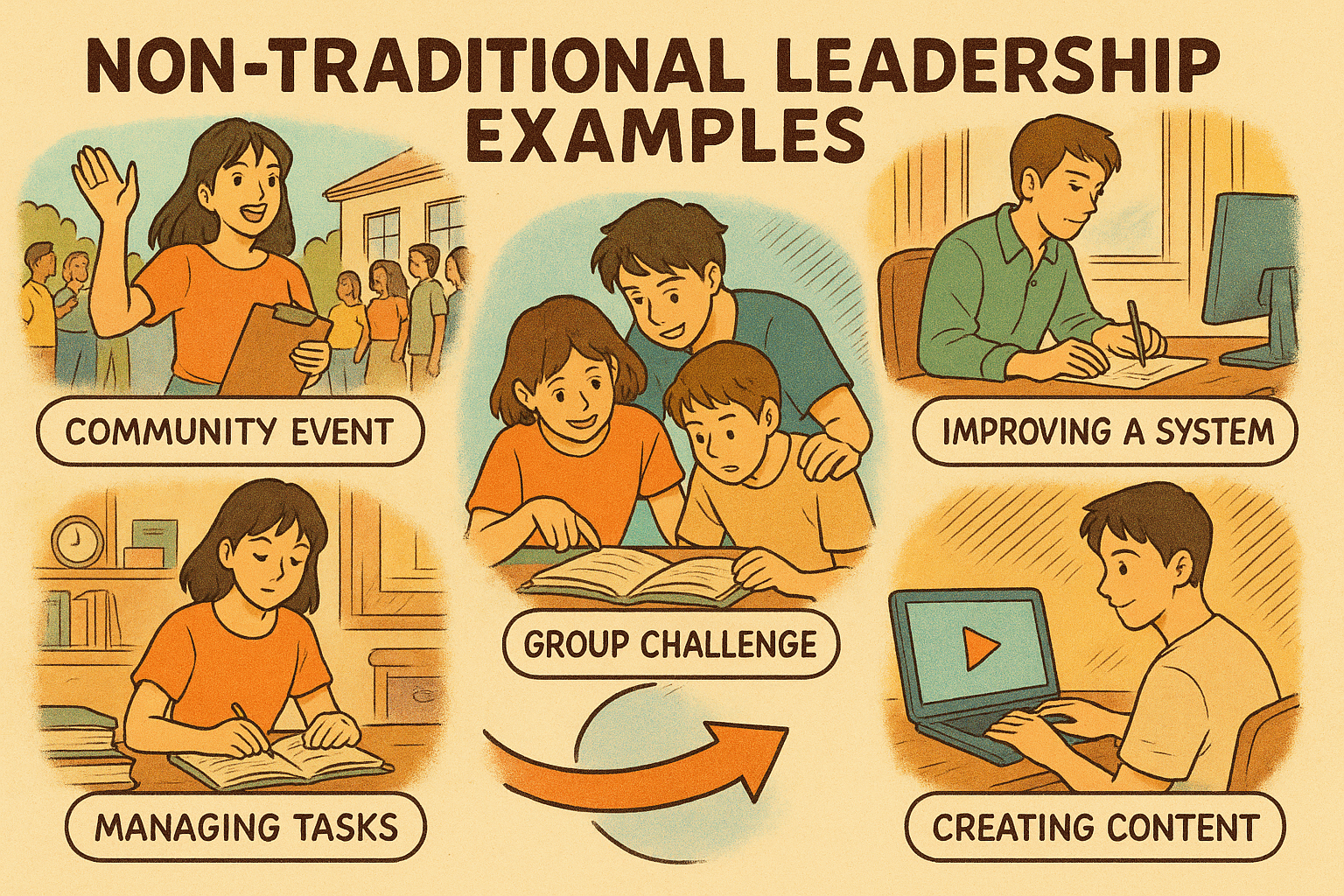
- Noticing a need in your community and organizing a response
- Taking the initiative to improve a process or system
- Stepping up during a challenging situation when no one else would
- Advocating for positive change within an organization
- Mentoring younger students without a formal program
- Managing family responsibilities while balancing academics
- Creating original content that educates or inspires others
If you're looking for extracurricular activity inspiration, see Unique Extracurricular Activities That Impress Top Universities and Best Extracurricular Activities For Ivy League Admissions Success.
The key is demonstrating how you identified a need, took initiative, and made a positive difference—whether or not you had an official title.
Demonstrating Leadership in Applications The Dos and Donts
Demonstrating leadership in applications effectively requires strategic storytelling, not just listing achievements. The most compelling essays show rather than tell, using specific examples to illustrate leadership qualities.
Storytelling vs Listing
DO: Craft narratives that show your leadership journey through specific situations, actions, and outcomes.
DON'T: Simply state "I am a leader" or list leadership positions without context.
The New York Times advises students to "show the admissions committee who you are through specific stories and examples rather than telling them through general statements." This storytelling approach creates memorable, authentic essays that stand out.
To develop your story beyond a mere list of activities, read our College Application Essays Guide To Writing Compelling Personal Statements.
Effective Framework for Demonstrating Leadership
Structure your leadership stories using this framework:
- Challenge/Opportunity: Describe the situation that required leadership
- Action/Initiative: Explain what you did and how you approached it
- Impact on Others: Detail the positive difference your actions made
- Personal Growth: Reflect on what you learned and how you developed
Using phrases like "I noticed a need for..." or "I took the initiative to..." naturally demonstrates leadership without explicitly claiming to be a leader.
Effective Framework for Demonstrating Leadership
| Framework Element | Purpose | Example Phrasing |
|---|---|---|
| Challenge/Opportunity | Sets context and establishes need | When our club membership dropped by 50%... |
| Action/Initiative | Shows your specific leadership approach | I developed a new recruitment strategy by... |
| Impact on Others | Demonstrates meaningful results | By the end of the semester, we had doubled our membership and... |
| Personal Growth | Reveals self-awareness and development | Through this experience, I learned the importance of... |
Use this framework to organize your leadership story in college essays.
Common Mistakes to Avoid
- Overused tropes: "As captain, I led by example" or "I turned a losing team into champions"
- Unsupported claims: Making broad statements about leadership without specific examples
- Missing reflection: Focusing only on achievements without sharing personal growth
- Exaggeration: Inflating your role or the impact of your actions
U.S. News & World Report notes that "admissions officers can spot inauthentic essays," emphasizing the importance of honesty and genuine reflection when demonstrating leadership in applications.
For a list of the most common college essay mistakes—and how to sidestep them—explore Successful College Applications Examples And Strategies That Work.
Analysis of Successful Common App Leadership Essays
Examining successful Common App leadership essays reveals effective strategies for showcasing leadership experiences. These leadership essay examples demonstrate how to structure narratives, incorporate reflection, and highlight impact.
Example 1: "The Lunch Table Initiative"
This essay described how a student noticed social divisions in their high school cafeteria and created a "random lunch table assignment" program to break down cliques and foster new friendships.
Key elements that made this leadership essay example effective:
- Attention-grabbing opening: "The cafeteria map told the whole story of our school's invisible boundaries."
- Clear problem identification: The student specifically described the social segregation they observed
- Initiative description: Detailed the steps taken to create and implement the program
- Quantifiable impact: "By semester's end, 78% of participants reported making at least one new friend outside their usual circle"
- Personal reflection: "I learned that leadership isn't about having authority, but about having the courage to address problems others ignore"
The essay succeeded by showing the student's ability to identify a community issue, develop a creative solution, and measure its impact—all qualities admissions officers value.
Example 2: "Leading From the Middle"
This essay focused on a student who wasn't the team captain but took initiative during a crisis when the team's leadership faltered.
Effective elements:
- Honest context: Acknowledged not having a formal leadership position
- Specific situation: Described a tournament where team morale collapsed after early losses
- Action steps: Detailed how they organized team meetings, created a new strategy, and rebuilt confidence
- Growth focus: Reflected on discovering their leadership style and voice
- Broader application: Connected this experience to other situations where they've led without authority
This example effectively demonstrates that leadership in college essays doesn't require formal titles—it's about stepping up when needed and making a positive difference.
If you're seeking more real examples, see Common App Essay Examples To Inspire Your College Application Success.
Analysis of Successful Common App Leadership Essays
| Essay Element | Example 1: "The Lunch Table Initiative" | Example 2: "Leading From the Middle" |
|---|---|---|
| Leadership Context | Student created program to address social segregation | Student stepped up during team crisis without formal position |
| Problem Identified | Cafeteria cliques creating social divisions | Team morale collapse during important tournament |
| Action Taken | Created random lunch table assignment program | Organized team meetings and developed new strategy |
| Measurable Impact | 78% of participants made new friends outside their circle | Team recovered and performed better in remaining matches |
| Personal Reflection | Leadership is about addressing ignored problems | Discovered personal leadership style without needing a title |
Comparison of two effective leadership essay examples.
Selecting and Showcasing Leadership Extracurriculars for College Admissions
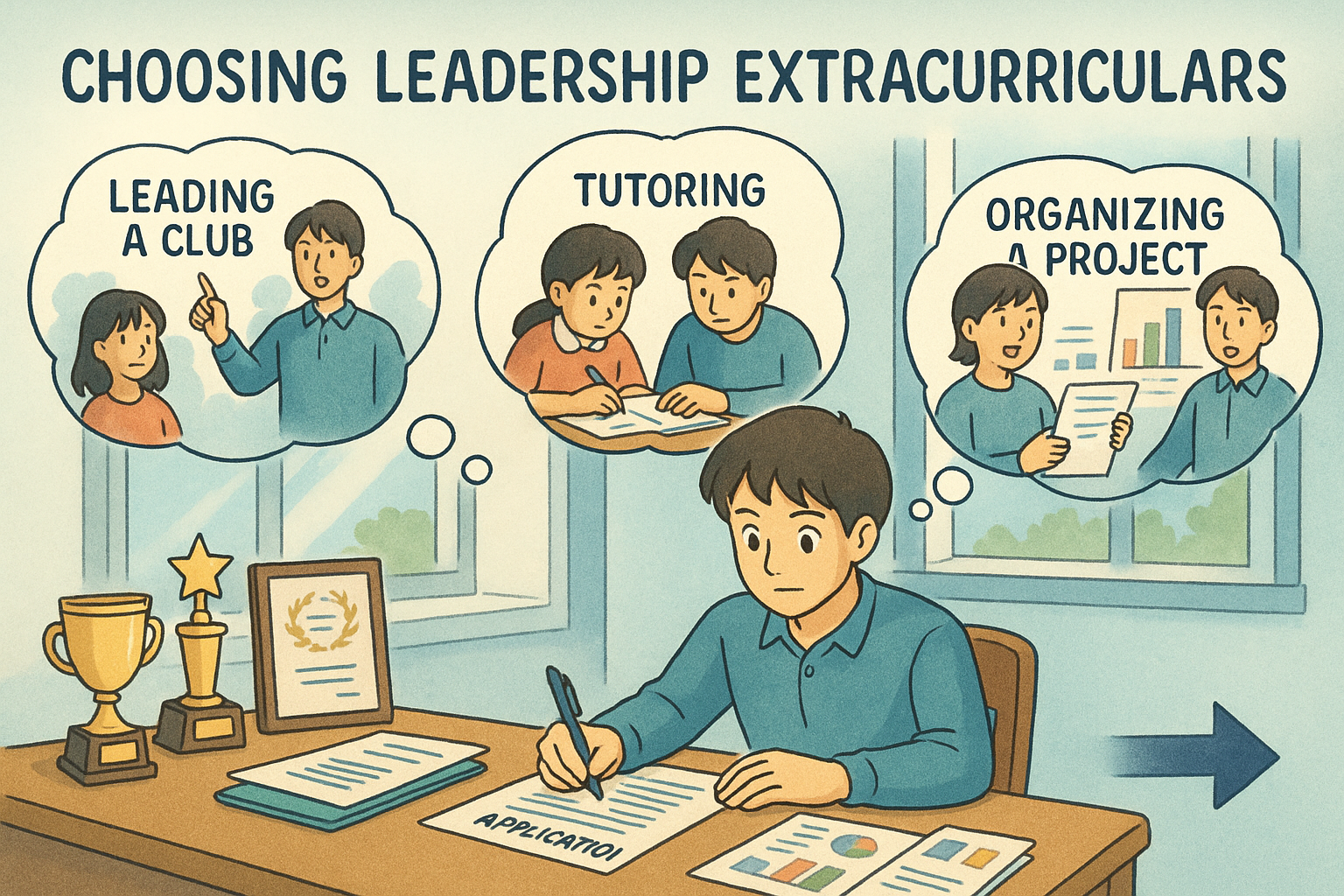
When highlighting leadership extracurriculars college admissions officers value, strategic selection and presentation make all the difference. Not all activities carry equal weight—what matters is how you frame your involvement and impact.
Aligning Activities with Your Application Narrative
Select college application leadership activities that:
- Connect to your intended major or career interests
- Demonstrate sustained commitment and progression
- Show diverse skills and perspectives
- Reflect your authentic interests and values
PrepScholar advises, "Admissions officers look for depth rather than breadth. A few meaningful leadership experiences where you've made a significant impact are more valuable than a long list of superficial involvements."
For more on showcasing your extracurriculars with a leadership angle, view College Admission Case Studies That Lead To Real Application Success and Online Extracurricular Activities To Boost Your College Applications.
Tips for Showcasing Leadership Activities
- Choose quality over quantity: Focus on experiences where you had meaningful impact
- Highlight growth trajectory: Show how your responsibilities increased over time
- Quantify your impact: Use specific numbers (people affected, money raised, participation increased)
- Connect to personal values: Explain why these activities mattered to you
- Show initiative: Emphasize instances where you identified needs and created solutions
Integrating Leadership into Different Application Components
- Activities list: Use action verbs and quantifiable achievements in descriptions
- Essays: Develop detailed narratives around significant leadership experiences
- Supplemental questions: Connect leadership experiences to specific programs or values at each college
- Recommendations: Brief recommenders on leadership experiences they could highlight
Remember that college application leadership activities should tell a cohesive story about who you are and what you'll bring to campus.
What Admissions Officers Really Look For in Leadership Essays
Understanding the admissions perspective helps you craft more effective leadership in college essays. Admissions professionals consistently emphasize certain qualities when evaluating leadership experiences.
Direct Insights from Admissions Professionals
Harvard's admissions office notes that they look for "substantial commitments to activities, organizations, work, or family where the applicant has made a meaningful contribution and taken on a leadership role." The emphasis is on impact and contribution, not just holding a position.
Johns Hopkins University showcases "Essays That Worked" on their admissions website, with one admissions officer commenting: "We're looking for students who have made the most of their opportunities, whatever those opportunities might be. Leadership isn't about titles—it's about taking initiative to improve situations around you."
If you want practical advice on understanding the overall application and admissions process, visit College Application Guide For Successful University Admissions.
Green Flags in Leadership Essays
Admissions officers respond positively to essays that demonstrate:
- Authenticity and humility: Honest reflection that acknowledges both successes and challenges
- Specific examples: Detailed situations that illustrate leadership in action
- Impact on others: Clear evidence that your actions benefited your community
- Personal growth: Insights about how leadership experiences changed your perspective
- Initiative: Examples of identifying problems and creating solutions without being prompted
- Collaboration: Recognition of how you worked with others to achieve goals
Red Flags to Avoid
- Generic leadership claims: Broad statements without supporting evidence
- Focus on prestige: Emphasizing the title rather than the impact
- Lack of reflection: Describing events without personal insight
- Taking full credit: Failing to acknowledge others' contributions
- Artificial language: Using overly formal or thesaurus-heavy writing
When demonstrating leadership in applications, remember that admissions officers value authenticity over perfection.
Common Pitfalls in Writing About Leadership
Even strong candidates make mistakes when writing leadership in college essays. Avoiding these common pitfalls will strengthen your application significantly.
Frequent Errors in Leadership Essays
- Relying on leadership clichés
- "I led by example"
- "I was born a natural leader"
- "I transformed the organization overnight"
These phrases appear in thousands of essays and fail to differentiate you from other applicants.
- Focusing exclusively on achievements
- Listing accomplishments without explaining the process
- Emphasizing personal success rather than team impact
- Neglecting to share challenges or setbacks
- Exaggerating or fabricating stories
- Inflating your role or responsibility
- Claiming unrealistic outcomes
- Creating leadership scenarios that didn't occur
- Lacking honest self-reflection
- Missing opportunities to share what you learned
- Avoiding discussion of mistakes or growth areas
- Presenting yourself as perfect rather than developing
- Telling rather than showing
- Stating "I am a leader" without supporting evidence
- Using abstract descriptions instead of concrete examples
- Relying on adjectives rather than actions
For expert assistance with your writing process, consider reading Personal Statement Writing Service Tips For Stronger College Applications.
Actionable Tips to Avoid These Pitfalls
- Show vulnerability: Include challenges you faced and how you overcame them
- Discuss lessons learned: Reflect on how leadership experiences changed your perspective
- Admit mistakes: Share what you would do differently with hindsight
- Use specific examples: Include dialogue, details, and descriptions that bring your story to life
- Focus on growth: Emphasize how your leadership abilities developed over time
U.S. News advises, "The most compelling essays show a student who has reflected meaningfully on their experiences and can articulate what they've learned from them."
Resources and Next Steps

To further strengthen your leadership in college essays, explore these valuable resources for additional guidance, examples, and strategies.
Curated Resources for Leadership Essays
- Examplit's model leadership essays: Review successful essays with annotations explaining what worked
- College Essay Guy's "How to Write About Leadership": Detailed guide with frameworks and examples
- Common App prompts: Familiarize yourself with current essay questions and how they invite leadership stories
- College Board: What Counts as an Extracurricular? Comprehensive guide to activities colleges value
If you're looking to tackle the Common App specifically, see our in-depth Common App Essay Prompts Expert Guide For Powerful College Applications.
Step-by-Step Worksheet for Brainstorming Leadership Experiences
- Identify potential leadership stories:
List all positions, projects, and initiatives you've been involved with
Include family responsibilities and personal projects
Note situations where you took initiative without a formal role - Evaluate each experience:
What challenge or opportunity did you address?
What specific actions did you take?
How did your actions impact others?
What did you learn from this experience? - Select your strongest examples:
Which stories demonstrate the most significant impact?
Which experiences taught you the most?
Which narratives best align with your overall application? - Outline your essay:
Engaging introduction that establishes context
Detailed description of the situation and your actions
Clear explanation of impact and outcomes
Meaningful reflection on personal growth
Connection to future goals or values
Next Steps
- Draft your leadership essay using the frameworks and examples provided
- Review for authenticity, specificity, and reflection
- Get feedback from teachers, counselors, or trusted mentors
- Revise to strengthen your narrative and eliminate clichés
- Ensure your essay aligns with other application components
Remember that college application leadership activities should be presented consistently across your entire application, creating a cohesive narrative about who you are and what you'll contribute to campus.
Conclusion Key Takeaways for Leadership in College Essays
Leadership in college essays requires thoughtful reflection, specific examples, and authentic storytelling. Throughout this guide, we've explored how to effectively showcase your leadership experiences in ways that resonate with admissions officers.
Remember these essential points:
- Leadership is multi-dimensional, encompassing formal positions, project initiatives, family responsibilities, and personal advocacy
- Stories matter more than titles—focus on specific situations where you identified needs and took action
- Impact and growth are crucial elements—show how your leadership benefited others and changed your perspective
- Authenticity trumps perfection—honest reflection about challenges and lessons learned strengthens your essay
To see more success strategies and inspiring application journeys, read Success Stories Of Students Who Overcame Challenges To Achieve Their Dreams.
Demonstrating leadership in applications effectively means moving beyond generic claims to show your unique contributions and personal development. By applying the strategies outlined in this guide, you can craft compelling essays that authentically showcase your leadership potential.
As you work on your college essays, remember that leadership isn't about being perfect—it's about taking initiative, making a positive difference, and growing through experience. These are the qualities that truly impress admissions officers and set strong applications apart.
Leadership in college essays ultimately reveals who you are beyond grades and test scores—it shows how you'll contribute to campus life and what kind of community member you'll become. By telling your leadership stories effectively, you give admissions officers compelling reasons to welcome you to their incoming class.
Frequently Asked Questions
What if I don't have traditional leadership positions to write about?
For more creative ways to demonstrate leadership without a title, see Leadership Development Program Guide For High School Students.
How specific should my leadership examples be?
For additional inspiration, browse Personal Statement Examples You Can Use For University And Masters Success.
Can I write about a leadership failure?
Read Addressing Weaknesses In College Applications With Proven Strategies And Expert Advice for more on turning challenges into powerful application stories.
Should I use the word 'leadership' throughout my essay?
If you want your story to flow naturally, don't miss our How to Write a Successful College Essay That Stands Out guide.
How do I balance humility with showcasing achievements?
For more tips on genuine self-presentation, see our College Application Guide For Successful University Admissions.
Can I discuss informal leadership experiences like family responsibilities?
If you want to connect personal responsibility to your larger academic journey, try College Admission Case Studies That Lead To Real Application Success for more relatable stories.