Table of Contents
- Freshman Year 2022-2023: Building Your Foundation
- Sophomore Year 2023-2024: Expanding Your Horizons
- Junior Year 2024-2025: The Critical Year
- Senior Year Fall 2025: Application Season
- Senior Year Winter-Spring 2026: Decision Time
- Summer Before College 2026: Preparing for Transition
- Special Considerations for the 2025-2026 Admissions Cycle
- College Application Checklist for 2025-2026
- College Admissions Process Steps: Breaking It Down
- High School Senior Year Timeline: Month-by-Month
- College Planning Calendar: Important Dates for 2025-2026
- College Application Deadlines 2025: Understanding Your Options
- College Admissions Timeline 2025-2026: FAQ
Freshman Year 2022-2023: Building Your Foundation
Your college journey kicks off the moment you walk through those high school doors. College might seem like it's ages away, but trust me, the groundwork you lay now will open or close doors later on.
During freshman year, you'll want to focus on building strong study habits and aiming for the best grades possible. Colleges don't just look at your junior and senior years—they examine your entire high school transcript. This is also the perfect time to explore activities that genuinely interest you. Instead of spreading yourself thin across a dozen clubs, find a few you're passionate about and stick with them.
Start thinking about potential career paths too. You don't need to have it all figured out, but begin exploring fields that match your interests. Work with your guidance counselor to create a four-year high school plan with courses that'll fulfill college requirements. And don't forget to build relationships with teachers and counselors—these connections will be invaluable when you need recommendation letters down the road.
As the admissions team at Central Michigan University puts it, "The freshman year is the perfect time to explore interests and begin building a foundation for college applications. Students should focus on academics while discovering extracurricular activities they're passionate about."
Source
Sophomore Year 2023-2024: Expanding Your Horizons
Sophomore year builds on your freshman foundation while nudging you closer to direct college prep. This is when things start getting real, but in a good way!
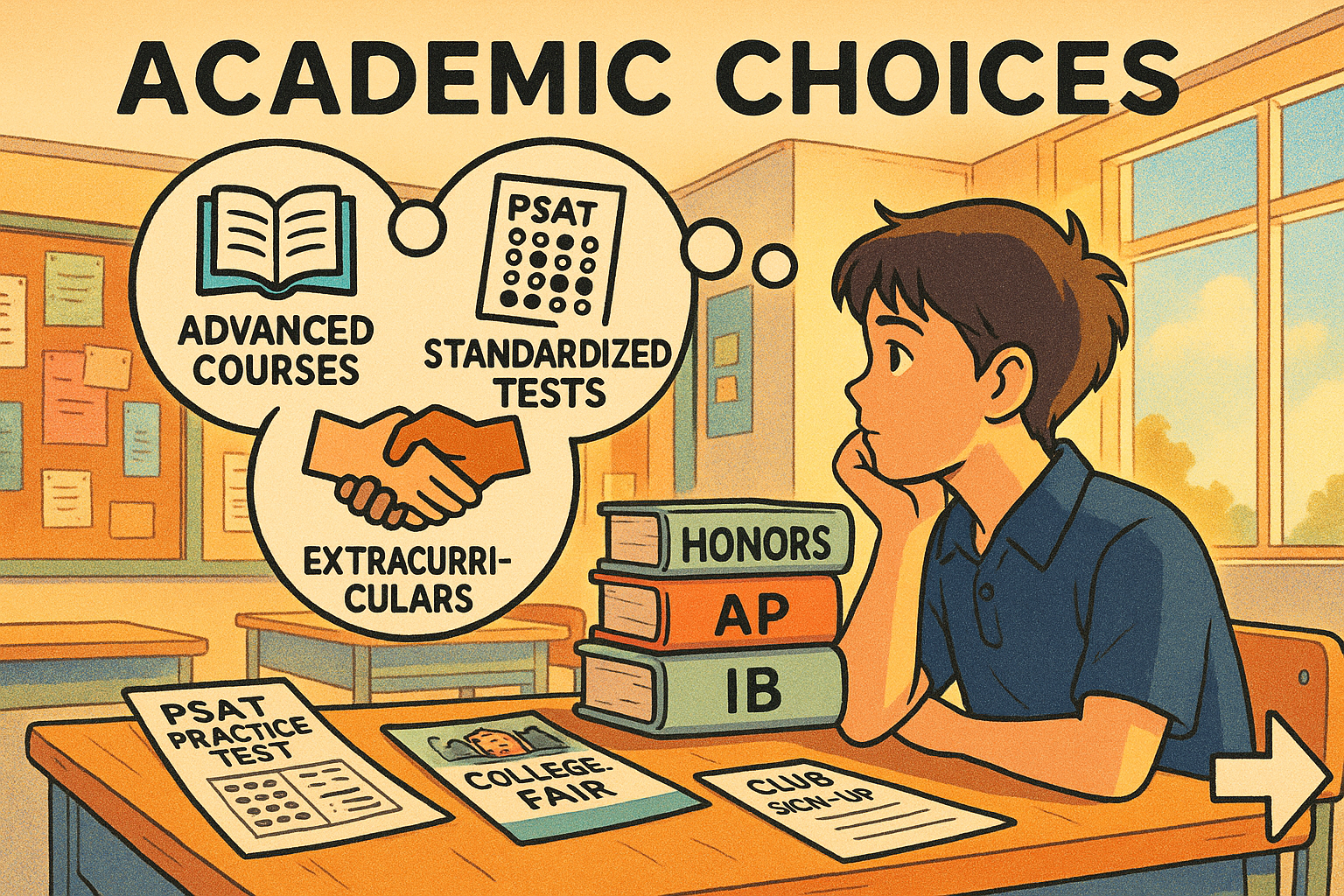
You'll want to take the PSAT/NMSQT or PreACT this year. Don't stress too much about your score—these tests are mainly to help you get comfortable with standardized testing formats. Consider challenging yourself with honors, AP, or IB courses if they're right for your abilities. No need to overload, but stretching yourself academically shows colleges you're serious.
It's also time to deepen your extracurricular involvement. Maybe aim for a leadership role in that club you joined last year, or take on more responsibility in your volunteer work. Start researching college majors that align with what you enjoy and excel at. You don't need to decide yet, but it helps to explore options.
Attend a few college fairs to get a feel for different types of schools. And don't forget to think about summer opportunities—academic programs, internships, or meaningful volunteer work can really enhance your profile.
As the college planning experts at MyFuture.com note, "Sophomore year is when students should begin thinking more concretely about college. Taking the PSAT and researching potential majors helps students start narrowing their focus while still keeping options open."
Source
Junior Year 2024-2025: The Critical Year
Junior year is when the college process shifts into high gear. This is the year that really counts, and your actions now directly impact your applications. Let's break it down by semester to keep things manageable.
Fall Semester August-December 2024
The fall of junior year kicks off with taking the PSAT/NMSQT in October. This isn't just practice anymore—a great score could qualify you for National Merit Scholarships. It's also time to get serious about college research. Create a preliminary list of 15-20 schools that catch your interest based on size, location, majors, and campus vibe.
Schedule a meeting with your counselor to discuss your college plans and make sure you're on track with all requirements. You'll also want to plan your standardized testing schedule—most juniors take their first SAT/ACT in winter or spring.
Attend college fairs and information sessions whenever possible. These events give you face time with admissions reps and help you gather detailed info about potential schools. And don't put off researching financial aid and scholarships—understanding the types of aid available and eligibility requirements now will save you stress later.
Spring Semester January-May 2025
Spring semester is test time for most juniors. You'll likely take your first SAT/ACT exams during winter or spring. Some selective colleges also recommend or require SAT Subject Tests, so research whether these make sense for your target schools.
If possible, schedule some campus visits during spring break. There's nothing like walking around a campus to get a feel for whether it's right for you. Use these visits to help narrow your college list to approximately 8-12 schools.
Before junior year ends, approach teachers about recommendation letters. The best recommenders are teachers who know you well and can speak to your academic abilities and personal qualities. You'll also want to prepare for any AP/IB exams—strong scores can earn you college credit and demonstrate your academic prowess.
Start researching specific application requirements for schools on your list. Some programs require portfolios, auditions, or specific essays beyond the standard application. For a step-by-step breakdown of each phase, refer to our College Application Guide For Successful University Admissions for an in-depth look at preparing every component.
Summer Before Senior Year June-August 2025
The summer before senior year is crucial for getting ahead on applications. Visit any additional colleges still on your list and continue refining your choices. The Common Application typically releases essay prompts in August, so you can start drafting your personal statement.
Create a detailed application calendar noting all deadlines for each school—early decision, regular decision, scholarship deadlines, the works. If you're planning to retake the SAT/ACT in the fall, use some summer time to prepare.
Update your resume with all activities, honors, and work experience from the past three years. And research early decision/early action options to determine if these application strategies fit your plans.
As Boston Magazine's education experts point out, "Junior year is the most critical time in the college planning process. This is when students should be finalizing their testing plans, visiting campuses, and beginning to narrow down their college lists based on academic fit, location, size, and other personal preferences."
Source
Senior Year Fall 2025: Application Season
Fall of senior year is application season—the culmination of all your preparation. This period requires serious organization and attention to deadlines. Let's break it down month by month to keep you on track. For more on aligning your tasks with recommended deadlines, review our Your College Application Timeline Guide to Planning and Success and complement it with College Application Timeline Guide for a Successful Admissions Journey for testing, recommendations, and financial aid submission windows.
September 2025
September is all about finalizing your college list and categorizing schools as reach, match, and safety options. You'll want to set up your application accounts—Common App, Coalition App, or individual college portals—and request official test scores to be sent to your schools.
Follow up with teachers and counselors about recommendation letters and begin applications for Early Decision/Early Action if you're going that route. These deadlines typically fall in November, so you'll need to work efficiently.
Continue attending college visits and fairs to research and connect with admissions representatives. And don't forget to check for special scholarship deadlines—some merit scholarships have early application dates you won't want to miss.
October 2025
October 1st marks the opening of the FAFSA (Free Application for Federal Student Aid), which you should complete as soon as possible. Some schools also require the CSS Profile for institutional aid, so check if your colleges need this form.
This is the month to finalize Early Decision/Early Action applications—polish those essays and review all materials carefully. You'll also need to request first quarter transcripts for early applications.
October is typically the last testing date for early applications, so if you're retaking the SAT/ACT, make sure you're prepared. While focusing on early applications, don't neglect your Regular Decision applications—start drafting those essays and gathering materials.
November 2025
November is crunch time for Early Decision/Early Action applications, with most deadlines falling between November 1-15. Once those are submitted, shift your focus to Regular Decision applications, particularly the essays and supplemental materials.
Follow up on recommendations and transcripts to ensure all supporting documents have been submitted. This is also a good time to research additional scholarship opportunities and apply for private and local scholarships.
And don't let senioritis set in! Maintaining strong academic performance remains crucial—senior year grades matter significantly and can impact admission decisions.
December 2025
Mid-December brings Early Decision/Early Action results. Whether you're celebrating an acceptance or processing a deferral or denial, you'll need to stay focused on completing Regular Decision applications, many of which have January 1 deadlines.
December is typically the last testing date for Regular Decision applications, so complete any remaining standardized tests. Continue applying for scholarships, as many deadlines fall between December and February.
Before winter break, request midyear grade reports—some colleges require first-semester senior grades as part of your application package.
Senior Year Winter-Spring 2026: Decision Time
After submitting applications, the focus shifts to financial planning and ultimately making your college decision. This period is all about evaluating options and preparing for the transition to college life.
January-February 2026
January and February are for submitting any remaining applications and ensuring your financial aid forms are complete. Double-check that all your colleges have received your complete application packages—including transcripts, test scores, and recommendations.
If your FAFSA was selected for verification, you'll need to submit additional documentation to confirm the information you provided. This is also a good time to research housing options at the schools you're most interested in.
Keep applying for regular admission scholarships, as many institutional scholarships have winter deadlines. And don't slack off academically—colleges can and do rescind offers if your grades drop significantly in senior year.
March-April 2026
March and April bring the moment of truth—most Regular Decision results arrive in late March or early April. Once you have all your acceptances, it's time to compare financial aid packages and evaluate the affordability of each option.
Try to attend admitted student events at your top-choice schools. There's nothing like experiencing campus as an admitted student to help you make your final decision. If your financial circumstances have changed or if you received significantly better offers from comparable schools, consider appealing your financial aid package.
If you've been waitlisted at any schools, decide whether you want to remain on those waitlists and send a letter of continued interest if appropriate. For expert tips to handle this phase effectively, read our Waitlist Strategy Tips To Maximize Your Admission Chances.
May 2026
May 1st is National College Decision Day—the deadline to submit your enrollment deposit to your chosen school. Once you've made your decision, be sure to notify other colleges that accepted you so they can offer your spot to waitlisted students.
Request that your high school send your final transcript to your chosen college, and complete any housing applications to secure on-campus living arrangements if that's your plan. Register for orientation sessions, which typically take place during summer or early fall.
If you're taking AP or IB exams, now's the time to finish strong—good scores may earn you college credit and potentially save you time and money.
Summer Before College 2026: Preparing for Transition
The summer before college is all about practical preparations and getting emotionally ready for this huge life transition.
You'll want to attend your college's orientation program, where you'll register for classes with the help of an advisor. Complete all required health forms and submit immunization records—these are mandatory at most institutions.
Finalize your financial arrangements by setting up payment plans or accepting student loans, and purchase necessary supplies like technology, dorm essentials, and textbooks. Connect with your roommates to coordinate dorm room supplies and start building that relationship.
Prepare academically by completing any summer reading or assignments your college has provided. And don't forget the emotional side of this transition—spend quality time with family and friends before you head off to your new adventure.
This summer is the perfect balance of practical preparation and savoring the moment before a significant life change.
Special Considerations for the 2025-2026 Admissions Cycle
The college admissions landscape keeps evolving, and there are some special factors to consider for the 2025-2026 cycle.
Many institutions adopted test-optional policies during the pandemic, and some have made these permanent. You'll need to research each college's current standardized testing requirements, as they vary widely. Even at test-optional schools, strong test scores can strengthen your application, so consider taking the SAT/ACT if you think you'll do well.
Colleges are increasingly tracking "demonstrated interest"—evidence that you're genuinely interested in attending their institution. This includes campus visits, attending information sessions, email interactions, and applying early. Keep records of all your interactions with potential colleges.
Your digital presence matters too. Admissions officers sometimes review applicants' social media profiles, so audit your online presence to ensure it presents you positively. You might even consider creating a professional digital portfolio showcasing your achievements and interests.
If you're thinking about taking a gap year before starting college in 2026-2027, research deferral policies at your target schools. Some readily grant deferrals, while others have strict policies or may require you to reapply completely. For a trends-based perspective on evolving application policies (including AI in admissions and diversity efforts), see What College Admissions Trends 2025 Mean for Your Application Success.
College Application Checklist for 2025-2026
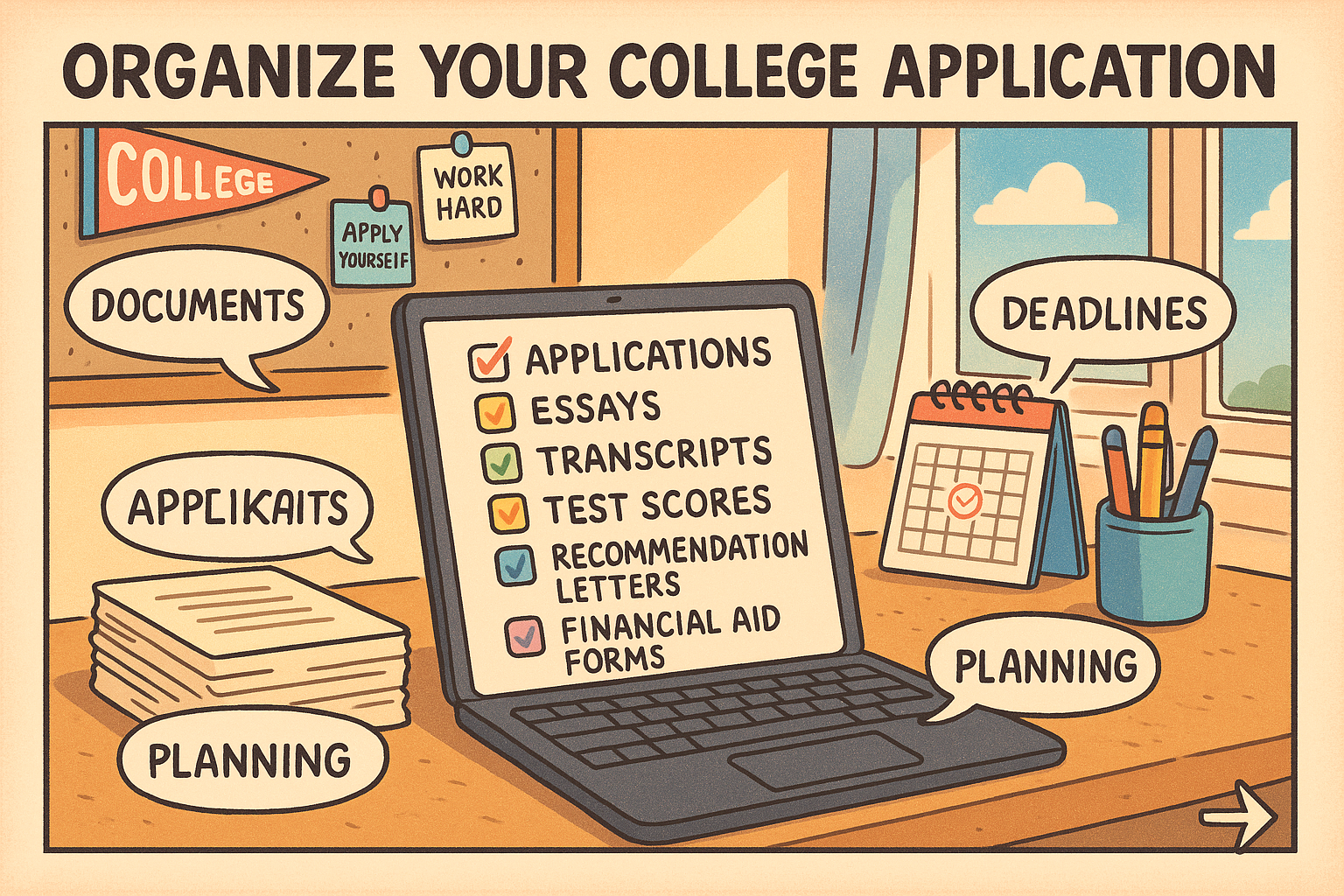
Staying organized is key to managing the application process. Here's a comprehensive checklist to ensure you don't miss any critical components:
- Application Materials: You'll need to prepare completed application forms (Common App, Coalition App, or institution-specific ones), application fees or fee waiver requests, your personal statement/main essay, and any supplemental essays specific to each college. Don't forget your activity list or resume, official high school transcript, standardized test scores (if submitting), and letters of recommendation (typically 2-3). Some colleges also require a mid-year grade report, arts supplements or portfolios for certain programs, and interviews if offered or required.
- Financial Aid Materials: Prepare to complete the FAFSA (opens October 1, 2025), the CSS Profile (if required by your colleges), and any institutional financial aid forms. You'll also need tax returns and income documentation, scholarship applications, and merit-based aid consideration forms. For more targeted tips on maximizing your aid with the CSS Profile, check out CSS Profile Application Guide To Maximize Financial Aid Success.
- Post-Acceptance Materials: Once accepted, you'll need to submit an enrollment deposit, housing application and deposit, orientation registration, and placement tests. You'll also request your final transcript, submit AP/IB scores, and complete health forms and immunization records.
Keeping track of all these components for each school can be overwhelming, so consider creating a spreadsheet or using an app to monitor deadlines and requirements.
College Admissions Process Steps: Breaking It Down
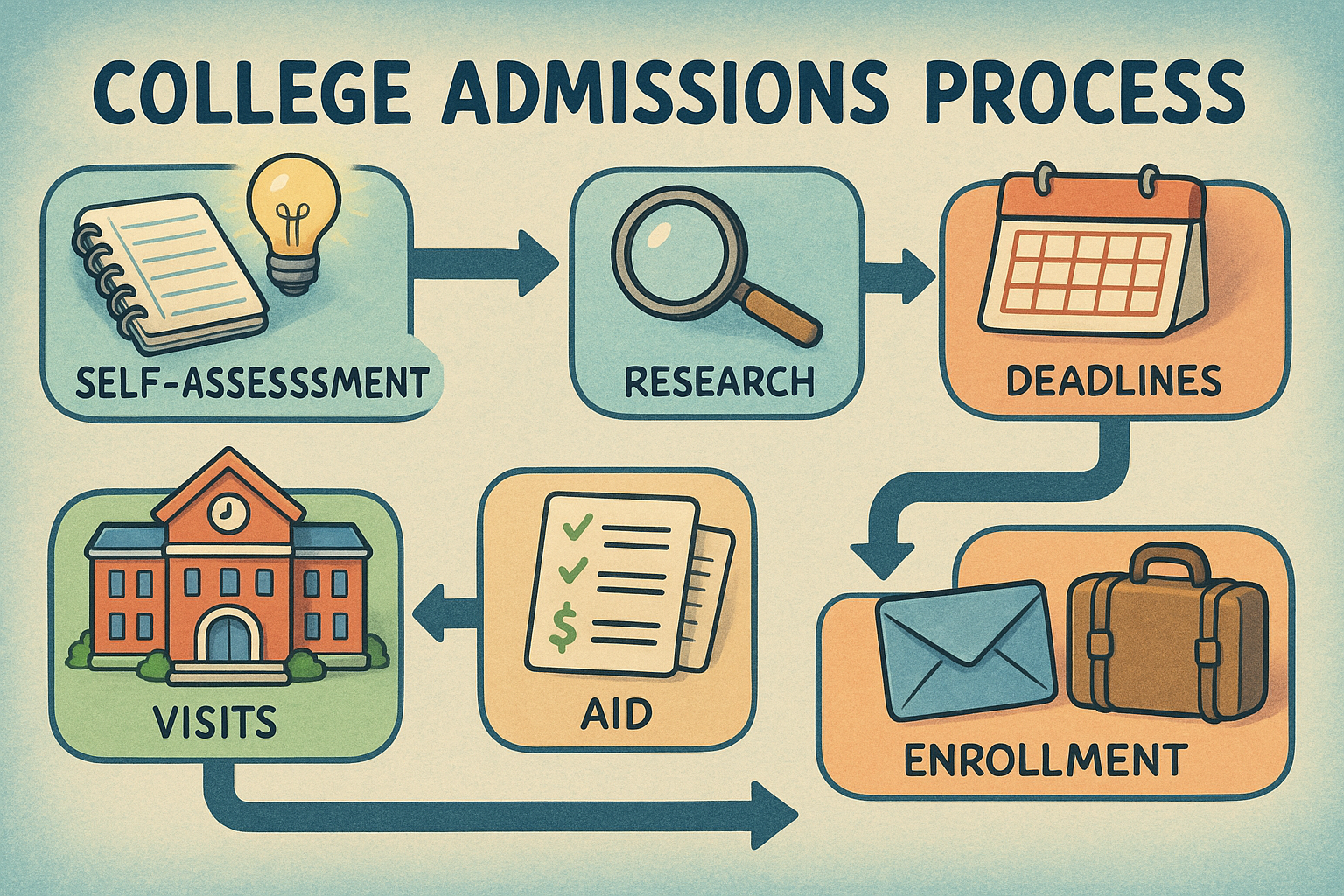
The college application process involves several key steps that build upon each other. Understanding this progression helps make the process more manageable.
It starts with self-assessment—evaluating your academic profile, interests, and college preferences. What kind of environment do you thrive in? What majors interest you? What location and size feel right?
Next comes research—identifying colleges that match your criteria and learning about their programs. This leads to testing—preparing for and taking standardized tests if required or beneficial for your target schools.
Visiting campuses, either virtually or in-person, helps you assess fit and demonstrate interest. Then you'll move into application preparation—gathering materials and drafting those all-important essays.
The submission phase involves completing and submitting applications by their respective deadlines. This is followed by financial planning—applying for financial aid and scholarships to make college affordable.
Once acceptances arrive, you enter the decision-making phase—comparing acceptances and financial packages to determine your best option. After committing to your chosen institution, you'll focus on enrollment tasks and finally transition preparation—getting academically and emotionally ready for college.
As MyFuture.com's college planning experts explain, "Understanding the college application process as a series of manageable steps helps students stay organized and reduces stress. Breaking down this complex process into smaller tasks makes it less overwhelming and ensures nothing falls through the cracks."
Source
If you want a comprehensive visual calendar and more application process details, visit our Master the College Admissions Timeline and Secure Your Place at Top Schools for further resources and downloadable planning tools.
High School Senior Year Timeline: Month-by-Month
Senior year flies by, with each month bringing new tasks and deadlines. Here's a detailed monthly breakdown to keep you on track:
High School Senior Year Timeline: Month-by-Month
| Month | Key Tasks |
|---|---|
| August 2025 | Finalize college list, create application accounts, begin drafting essays |
| September 2025 | Register for fall SAT/ACT if needed, request recommendation letters, work on early applications |
| October 2025 | Submit FAFSA and CSS Profile, complete Early Decision/Action applications, attend college fairs |
| November 2025 | Submit early applications, begin Regular Decision applications, research scholarships |
| December 2025 | Receive early application results, complete Regular Decision applications, request midyear grades |
| January 2026 | Submit any remaining applications, follow up on materials, continue scholarship applications |
| February 2026 | Check application status at all colleges, complete verification if selected, research housing |
| March 2026 | Receive Regular Decision results, compare financial aid packages, visit campuses |
| April 2026 | Make final comparisons between colleges, negotiate financial aid if needed, prepare for decision |
| May 2026 | Submit enrollment deposit by May 1, notify other colleges, request final transcript |
| June 2026 | Complete housing forms, register for orientation, prepare for transition |
| July-August 2026 | Attend orientation, register for classes, prepare for move-in |
A month-by-month checklist for high school seniors to stay organized during the college application process.
College Planning Calendar: Important Dates for 2025-2026
Mark these key dates on your calendar for the 2025-2026 admissions cycle:
College Planning Calendar: Important Dates for 2025-2026
| Date | Event |
|---|---|
| August 1, 2025 | Common Application opens for 2026 admission |
| October 1, 2025 | FAFSA and CSS Profile become available |
| November 1-15, 2025 | Most Early Decision/Early Action deadlines |
| December 15, 2025 | Typical notification date for early applications |
| January 1-15, 2026 | Many Regular Decision application deadlines |
| February 15, 2026 | Priority deadline for many state financial aid programs |
| March 1-April 1, 2026 | Regular Decision notifications released |
| May 1, 2026 | National College Decision Day (deposit deadline) |
| June 1, 2026 | Housing application deadlines at many colleges |
| July-August 2026 | Orientation sessions and class registration |
Crucial college application and enrollment dates for the 2025-2026 academic year.
College Application Deadlines 2025: Understanding Your Options
Different application plans have different deadlines and requirements. Understanding these options helps you develop a strategic approach:
College Application Deadlines 2025: Understanding Your Options
| Application Plan | Typical Deadline | Notification | Commitment | Best For |
|---|---|---|---|---|
| Early Decision (ED) | Nov 1 or 15, 2025 | Mid-Dec 2025 | Binding—if accepted, you must attend | Students with a clear first-choice school ready to apply early |
| Early Action (EA) | Nov 1 or 15, 2025 | Mid-Dec 2025 | Non-binding—you can apply to other schools | Students seeking early decisions without making a binding commitment |
| Restrictive Early Action (REA) | Nov 1, 2025 | Mid-Dec 2025 | Non-binding, but restricts applying early to other private institutions | Students with a strong preference for one selective institution |
| Regular Decision (RD) | Jan 1-15, 2026 | Late Mar to early Apr 2026 | Non-binding—you can choose among all acceptances | Students who need more time to improve their academic record or test scores |
| Rolling Admission | Varies, often Sep 2025 through spring 2026 | Usually 4-8 weeks after submission | Non-binding, but spots fill as applications are accepted | Students applying to less selective institutions or as safety schools |
A comparison of major college application options, deadline types, commitment levels, and who they're best suited for.
College Admissions Timeline 2025-2026: FAQ
Let's address some common questions about the college admissions process for 2025-2026: