
Table of Contents
- Understanding Auburn University Admissions
- Auburn University Application Checklist
- Auburn Admission Requirements
- StepbyStep Auburn University Application Process
- Auburn Application Deadlines
- Auburn Acceptance Rate and Competitiveness
- Auburn University Application Tips
- Auburn University Application Portal Guide
- Financial Aid and Scholarships at Auburn
- Life at Auburn What to Expect After Acceptance
Understanding Auburn University Admissions

Thinking about joining the Auburn family? Located in Auburn, Alabama, this prestigious public research university draws thousands of hopeful students each year. And no wonder – with its stellar academic programs, lively campus atmosphere, and deep-rooted traditions, Auburn offers a college experience that's hard to beat.
When reviewing applications, Auburn doesn't just look at your grades. They want the full picture – your academic achievements, sure, but also your extracurricular activities, personal statements, and anything else that shows you've got what it takes to thrive there.
Here's some good news: Auburn's acceptance rate sits around 85%, making it more accessible than many other top public universities. But don't get too comfortable! That percentage doesn't mean you can coast through the application process. Meeting or exceeding their admission standards will dramatically boost your chances of getting that coveted acceptance letter.
The competition varies widely depending on your chosen program, with some majors being significantly more selective than others. That's why understanding the complete application process is so crucial – it helps you present yourself as the strongest possible candidate.
If you're looking for a full overview of the college admissions process and strategies, check out our comprehensive guide to the college admissions process as a perfect starting point for any applicant.
Auburn University Application Checklist
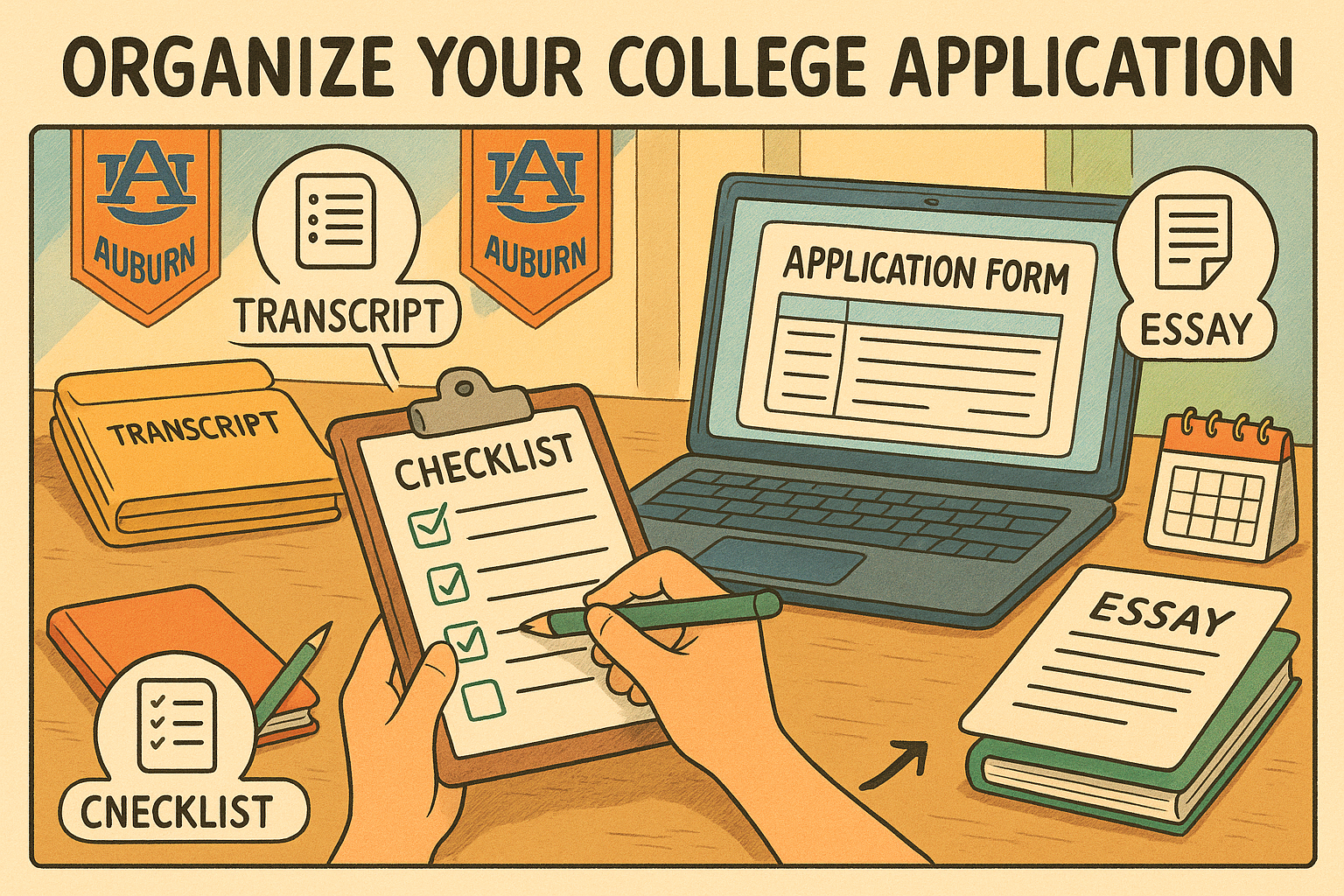
Before diving into the application process, let's get organized. Having everything ready beforehand will save you tons of stress and help ensure you don't miss anything important. Here's what you'll need to submit for a complete Auburn application:
First, you'll need to complete the online application – you can use either Auburn's own portal or the Common Application. There's a $60 application fee for all students, whether you're from Alabama or across the globe. You'll also need to submit your official high school transcripts and standardized test scores (though Auburn has been test-optional recently).
Don't forget about your personal statement or essay – this is your chance to shine beyond the numbers. Some programs might require letters of recommendation, so check if yours does. If you're hoping for in-state tuition, you'll need proof of Alabama residency too.
Certain programs have additional requirements that might include portfolios, auditions, or other specialized materials. Architecture, fine arts, and music programs often fall into this category, so research your specific program early.
Think of this checklist as your roadmap to a complete application. Having everything organized from the start makes the whole process much smoother and helps ensure you put your best foot forward when applying to become an Auburn Tiger.
For a broader checklist and preparation tips that apply to most universities, see our College Application Guide For Successful University Admissions.
Auburn Admission Requirements
Understanding what Auburn looks for in applicants is crucial for determining if you're a competitive candidate. The university has specific academic standards and also considers several other factors when evaluating potential students.
Academic Requirements
Auburn expects applicants to complete a solid college prep curriculum in high school. This typically includes 4 years of English, 3 years of math (covering Algebra I, Algebra II, and Geometry), 2 years of science (with Biology and a physical science), 1 year of history, 1 year of social studies, plus additional academic electives.
While Auburn doesn't publish a minimum GPA requirement, most competitive applicants have a GPA of 3.6 or higher on a 4.0 scale. If you're below this range, don't panic – other strengths in your application can help compensate.
As for test scores, Auburn has adopted a test-optional policy for recent admission cycles. This means you can apply without submitting ACT or SAT scores. However, strong scores can still strengthen your application, especially for scholarship consideration. Competitive applicants typically have ACT composite scores between 25-32 or SAT combined scores of 1150-1330.
For additional context on how to address academic weaknesses or overcome GPA concerns in your college application, see Addressing Weaknesses In College Applications With Proven Strategies And Expert Advice.
Academic Requirements
| Academic Factor | Typical Competitive Range |
|---|---|
| High School GPA | 3.6+ on 4.0 scale |
| ACT Composite | 25-32 |
| SAT Combined | 1150-1330 |
Table showing Auburn University's typical academic qualifications for competitive applicants.
Additional Considerations

Auburn takes a holistic approach to admissions, looking beyond just your academic record. They're interested in the complete picture of who you are and what you'll bring to campus.
Your extracurricular activities and leadership experiences carry significant weight. Auburn wants to see that you've been actively involved in your school and community. This might include clubs, sports, student government, or other organized activities where you've demonstrated commitment and growth.
If you're searching for ways to improve your extracurriculars or understand what impresses top colleges, take a look at our article on Unique Extracurricular Activities That Impress Top Universities.
Community service and volunteer work also matter. These experiences show your character and willingness to contribute to something larger than yourself – qualities highly valued in the Auburn community.
Do you have special talents or notable achievements? Whether in academics, arts, athletics, or other areas, these distinctions can help you stand out in the applicant pool.
Finally, Auburn considers your personal character and potential contributions to campus. They're building a diverse, engaged community and want students who will actively participate in and enhance campus life.
Remember, meeting these requirements doesn't guarantee acceptance, but it does position you as a competitive candidate in the applicant pool.
StepbyStep Auburn University Application Process
Let's break down the Auburn application process into manageable steps so you can tackle each one with confidence.
Step 1 Research Programs and Requirements
Before you even open the application, take time to explore Auburn's academic offerings. Browse through program descriptions, faculty profiles, and course catalogs to find the best fit for your interests and career goals. Some programs have additional requirements or earlier deadlines that you'll need to know about upfront. For instance, nursing, architecture, and honors college applications often have special components or timelines. Doing this research early saves headaches later and ensures you're applying to programs that genuinely excite you.
To ensure your research phase covers all the necessary bases, visit our step by step college admissions process guide for an in-depth look at how to get started.
Step 2 Create an Account
Head to Auburn's application portal and set up your account. You'll need a reliable email address that you check regularly – this becomes Auburn's main way to communicate with you throughout the application process. Choose a password you'll remember but that's secure enough to protect your information. After creating your account, you'll receive a confirmation email with instructions for accessing the application system. Keep your login information handy as you'll need to return to the portal multiple times.
Step 3 Complete the Application Form
Now for the main event – filling out the application itself. Take your time with this step and be thorough. The form will ask for your personal information, educational background, activities you've participated in, any jobs you've held, and which program you're interested in. You can usually save your progress and return later, so don't feel pressured to complete everything in one sitting. Double-check all information for accuracy before moving forward – small errors can cause delays in processing your application. For students applying to multiple colleges, consider reading our Common App guide for streamlining your college application process to save time and avoid common mistakes.
Step 4 Write Your Personal Statement
Your personal statement is where you get to shine beyond grades and test scores. Auburn wants to hear your unique voice and understand why you're interested in becoming part of their community. This essay is your opportunity to share your story, explain what draws you to Auburn specifically, and highlight qualities that might not be evident from the rest of your application. Be authentic, proofread carefully, and consider having a teacher or counselor review your statement before submission. A compelling personal statement can make a significant difference in a competitive applicant pool.
Need inspiration or want to see strong examples? Visit Personal Statement Examples You Can Use For University And Masters Success for tips and real samples.
Step 5 Submit Official Documents
Auburn needs official records directly from your high school and testing agencies. Contact your school counseling office to arrange for your transcripts to be sent to Auburn. If you're submitting test scores, request official reports from ACT or College Board (for SAT). These documents typically take time to process and deliver, so request them well before application deadlines. Keep track of when you've requested these materials and follow up if needed to ensure they arrive on time.
Step 6 Pay the Application Fee
The standard application fee is $60 for all applicants. You'll pay this through the online portal using a credit card or electronic check. If this fee presents a financial hardship, Auburn does offer fee waivers for eligible students. You'll need to request the waiver through the application portal and provide supporting documentation. Don't let the application fee be a barrier – reach out to Auburn's admissions office if you need assistance with this step.
Step 7 Check Application Status
After submitting your application, regularly monitor your status through Auburn's portal. The system will show which materials have been received and processed and will alert you if anything is missing. This step is crucial – many students assume everything is complete only to discover later that a document never arrived. Being proactive about checking your status helps ensure your application is complete by the deadline and gives you time to resolve any issues that arise.
For a detailed timeline on how to track applications and prioritize deadlines, see our College Application Timeline Guide for a Successful Admissions Journey.
Step 8 Complete ProgramSpecific Requirements
Some Auburn programs require additional components beyond the standard application. These might include portfolios for art or architecture programs, auditions for music or theater, or supplemental essays for the honors college. Check your specific program's requirements and complete these extra steps promptly. These program-specific elements often have their own deadlines, which might differ from the general application timeline. Following this comprehensive step-by-step process ensures you submit a complete and competitive application to Auburn University.
Auburn Application Deadlines
Meeting deadlines is absolutely critical when applying to Auburn. Missing a key date can take you out of the running entirely, no matter how strong your application might be. Let's break down the important dates you need to know.
Fall Semester Admission
For fall admission, Auburn offers two main application options. The Early Action deadline falls on November 1, with decisions typically released by December 15. This non-binding option gives you an early answer without requiring you to commit to Auburn if accepted.
If you need more time, the Regular Decision deadline is February 1, with notifications sent by April 1. While this gives you extra months to prepare your application, remember that some scholarships and programs fill up during Early Action.
Perhaps most importantly, Auburn's scholarship priority deadline is December 1. To receive maximum consideration for merit-based scholarships, you'll want to submit your complete application by this date. Even a day late could impact your financial aid opportunities.
For a side-by-side comparison with deadlines at other universities and comprehensive planning advice, visit College Application Deadlines Explained for a Successful Admissions Journey.
Fall Semester Admission
| Admission Type | Deadline | Decision By |
|---|---|---|
| Early Action | November 1 | December 15 |
| Regular Decision | February 1 | April 1 |
| Scholarship Priority | December 1 | Varies |
Table summarizing major Auburn undergraduate application deadlines.
Spring Semester Admission
Planning to start in January? The application deadline for spring semester admission is October 15. Auburn reviews these applications on a rolling basis, meaning they evaluate them as they arrive rather than waiting until after the deadline. This makes applying early advantageous – the sooner you submit, the sooner you'll receive a decision. Spring admission is less common than fall, so competition can be different, and some programs might not accept spring starts at all.
For more on how rolling admissions work and tips to take advantage of this flexibility, see our Rolling Admission Guide For College Applications And Acceptance Strategies.
Summer Semester Admission
For summer admission, applications are due by March 1. Like spring applications, summer decisions are made on a rolling basis. Starting in summer can be a great way to ease into college life with a lighter course load before the busy fall semester. It's also sometimes easier to secure housing and register for popular courses during summer terms. However, not all programs and scholarships are available for summer starts, so research your specific situation carefully.
ProgramSpecific Deadlines
Some of Auburn's most competitive programs have their own application timelines that differ from the general university deadlines. Nursing, architecture, interior design, and honors college applications often have earlier deadlines or additional application phases.
For example, the honors college might require a supplemental application after you've been admitted to Auburn, while nursing might have a separate professional program application after you complete prerequisites.
Always verify current deadlines on Auburn's official admissions website, as dates occasionally shift from year to year. Setting calendar reminders for these deadlines can help ensure you don't miss important submission dates.
Auburn Acceptance Rate and Competitiveness
Understanding where you stand in the applicant pool can help you develop a realistic application strategy. Auburn's overall acceptance rate hovers around 85%, which might seem pretty welcoming compared to some universities. But don't let that number fool you – the competitiveness varies dramatically depending on what you're applying for.
While Auburn accepts a majority of applicants overall, certain programs are much more selective. Engineering programs (especially aerospace and mechanical), nursing, architecture, business (particularly finance and accounting), and pre-veterinary medicine often accept fewer than half of applicants. These programs might have acceptance rates below 50%, making them significantly more competitive than the university average.
So what does this mean for you? If you're aiming for one of these competitive programs, you'll want to exceed the general admission requirements whenever possible. Strong grades in relevant coursework, compelling essays that demonstrate your passion for the field, and related extracurricular activities can help set you apart.
Timing also matters. Applying early action not only shows your interest but typically comes with slightly higher acceptance rates. The applicant pool tends to be smaller, and admissions officers have more spots available early in the cycle.
If you're concerned about your chances in a highly competitive program, consider these strategies: apply early, highlight specific experiences relevant to your chosen field, or consider applying to a less competitive program with plans to transfer internally later.
Remember that statistics only tell part of the story. Each application is evaluated individually, so focus on presenting your strongest possible case rather than worrying too much about the numbers.
For more insight into selective admissions, including strategies to stand out when applying to competitive programs, see What College Admissions Trends 2025 Mean for Your Application Success.
Auburn Acceptance Rate and Competitiveness
| Program | Approximate Acceptance Rate |
|---|---|
| University Overall | 85% |
| Engineering (Aerospace, Mechanical) | <50% |
| Nursing | <50% |
| Architecture | <50% |
| Business (Finance, Accounting) | 50-60% |
| Pre-veterinary Medicine | <50% |
Table of Auburn University acceptance rates by program.
Auburn University Application Tips
Want to maximize your chances of getting into Auburn? I've gathered some insider tips that can help your application stand out from the crowd.
Academic Preparation
Your academic record speaks volumes to admissions officers. Challenge yourself with the most rigorous courses available at your school – AP, IB, or dual enrollment classes show you're ready for college-level work. Don't ease up during senior year either! Auburn reviews final transcripts, and a significant drop in performance could jeopardize your acceptance.
If you're submitting test scores (remember, Auburn is test-optional), consider taking the ACT or SAT multiple times to achieve your best possible score. Many students see improvements on their second or third attempt. Focus your prep on areas where you scored lowest initially. Even a modest improvement could boost your scholarship eligibility.
For additional help with essays and personal statements, read our How to Write a Successful College Essay That Stands Out.
Application Strategy
Timing matters more than you might think. Applying early demonstrates genuine interest and gives you access to the full range of available spots and scholarships. When writing your personal statement, authenticity is key – admissions officers read thousands of essays and can spot generic content immediately.
Make sure to highlight what makes you unique. Maybe it's your passion for community service, your entrepreneurial spirit, or your dedication to a particular cause. Whatever sets you apart, make it shine in your application.
Show that you've done your homework about Auburn specifically. Reference particular programs, professors, or opportunities that attract you to the university. This demonstrates that you're not just applying to any school but have a genuine interest in becoming part of the Auburn family.
Financial Planning
Don't miss that December 1 scholarship priority deadline! Submitting by this date ensures you're considered for the maximum financial aid possible. Complete your FAFSA as soon as it opens on October 1 – some aid is first-come, first-served.
Beyond Auburn's institutional scholarships, research department-specific awards that might require separate applications. Many academic departments offer scholarships for incoming freshmen in their programs.
Don't overlook external scholarships either. Local community organizations, national corporations, and professional associations all offer scholarships that can supplement university aid. Even smaller scholarships of $500 or $1,000 can add up significantly over four years.
To prepare your full college financial plan, check out College Financial Planning Strategies For 2024.
After Applying
Your work isn't done once you hit submit! Respond promptly to any requests for additional information – delays could impact your admission decision. Consider visiting campus, either in-person or virtually, to demonstrate continued interest. These visits can also help you determine if Auburn truly feels like the right fit.
Maintain strong academic performance throughout your senior year. An acceptance can be rescinded if your grades drop significantly. Finally, don't hesitate to update Auburn with any significant achievements that occur after you've submitted your application – a major award, leadership position, or academic accomplishment could strengthen your standing.
These tips come from analyzing successful applications and feedback from admissions professionals. Implementing them thoughtfully can help distinguish your application in a competitive pool.
Auburn University Application Portal Guide
The application portal is your digital gateway to Auburn. Knowing how to navigate it effectively can save you time and prevent frustrating technical issues.
Creating Your Account
Getting started is straightforward. Visit Auburn's official application website and look for the "Create an Account" button. You'll need to provide a valid email address – use one you check regularly since this becomes Auburn's primary way to communicate with you. Create a secure password that you'll remember, as you'll be logging in multiple times throughout the application process.
After submitting your initial information, you'll receive a verification email with a link to activate your account. Click this link to confirm your email address and complete the account setup. If you don't see the email within a few minutes, check your spam folder before requesting another verification email.
Submitting Materials
The portal makes document submission relatively painless. You can complete application forms section by section, saving your progress as you go. This feature is particularly helpful for longer sections like activities and essays that might require multiple sessions to complete.
For supporting documents like personal statements, the portal typically allows direct uploads in PDF format. The system will also track receipt of materials sent separately, like official transcripts and test scores. You can pay application fees securely through the portal using a credit card or electronic check. If you qualify for a fee waiver, you'll request it through a specific section of the application.
Checking Status
After submission, the portal transforms into your tracking tool. You can confirm receipt of all required materials, which is crucial since missing documents are a common reason for delayed decisions. The system will flag any missing items so you can address them promptly.
When decision time arrives, you'll receive an email notification to check the portal for your admission decision. If accepted, you'll use the same portal to officially accept your offer of admission. Later, the portal provides access to housing applications, orientation registration, and other pre-enrollment steps.
Staying organized with application statuses and post-submission requirements is explored further in this College Admissions Timeline Guide.
Troubleshooting Common Issues
Even the best systems occasionally have hiccups. If you encounter problems with the Auburn application portal, try these solutions: First, clear your browser cache and cookies, then try again – this solves many common issues. If problems persist, try using a different browser altogether.
For technical difficulties that these steps don't resolve, look for the help link within the portal to contact technical support. For urgent matters or if you're approaching a deadline with portal problems, don't hesitate to call the admissions office directly.
Becoming familiar with the Auburn University application portal early in the process will help you avoid last-minute submission issues and ensure you can track your application effectively.
Financial Aid and Scholarships at Auburn
Let's talk money – because financing your Auburn education is just as important as getting accepted. Auburn offers various financial aid options to help make your education more affordable.
Types of Financial Aid Available
Auburn students can access several categories of financial assistance. Federal aid includes grants (like the Pell Grant), loans (such as Direct Subsidized and Unsubsidized Loans), and work-study opportunities that provide part-time employment while you study. These options all become available by completing the FAFSA.
If you're an Alabama resident, you might qualify for state-specific programs like the Alabama Student Assistance Program or various state scholarships. These programs often have separate applications beyond the FAFSA, so research what's available early.
Auburn itself offers institutional aid directly to students. This includes merit-based scholarships, need-based grants, and various specialty awards. Many of these are automatically considered when you apply for admission by the scholarship priority deadline.
Don't overlook private scholarships from organizations and foundations outside Auburn. These external funding sources can significantly reduce your out-of-pocket costs and, unlike loans, don't require repayment.
Scholarship Opportunities
Auburn's scholarship offerings are quite diverse. Academic scholarships reward strong GPA and test scores, with amounts varying based on your academic credentials. The most competitive academic scholarships can cover full tuition or more.
Leadership scholarships recognize students who have demonstrated exceptional leadership in school, community, or other settings. These often require evidence of your leadership roles and accomplishments.
Diversity scholarships promote campus diversity and may consider factors like cultural background, unique perspectives, or first-generation college student status. Departmental scholarships target students entering specific majors or programs and often consider both academic merit and interest in the field.
If you're a recruited athlete, athletic scholarships might be available through Auburn's NCAA Division I programs. And for children of Auburn alumni, legacy scholarships provide additional opportunities based on your family connection to the university.
Application Process for Financial Aid
The financial aid process has its own timeline and requirements. Start by submitting your FAFSA as early as possible after it opens on October 1. Include Auburn's school code (001009) to ensure your information is sent to the university.
To maximize scholarship consideration, apply for admission by the December 1 priority deadline. Many of Auburn's scholarships are awarded automatically based on your admission application, but some require additional steps.
Complete Auburn's scholarship application through the portal – this single application puts you in the running for multiple institutional scholarships. Also check for departmental scholarships that might require separate applications or materials like portfolios or essays.
For international students or those applying for additional need-based aid, review our College Application Timeline for International Students for more specific guidance.
Application Process for Financial Aid
| Financial Aid Type | Application Method | Deadline |
|---|---|---|
| Federal Aid (FAFSA) | fafsa.gov | As early as possible after October 1 |
| Auburn Merit Scholarships | Admission application | December 1 priority deadline |
| Departmental Scholarships | Varies by department | Typically December-February |
| External Scholarships | Individual applications | Varies by scholarship |
Table describing financial aid types, application methods, and key deadlines at Auburn.
Tips for Maximizing Financial Aid
Want to get the most financial support possible? Here are some proven strategies: First, meet all priority deadlines – late applications often miss out on limited funding pools. Apply for multiple scholarships both at Auburn and externally, even smaller awards that might seem less worth the effort.
Maintain strong academic performance throughout high school, as many scholarships are awarded based on final transcripts. Highlight your unique talents, achievements, and community service in your applications – scholarships often look beyond just grades.
Consider applying to Auburn's Honors College, which offers additional scholarship opportunities for accepted students. The Honors College application typically requires strong academic credentials and a separate application process.
Finally, don't hesitate to contact Auburn's financial aid office with questions or special circumstances. They can provide guidance specific to your situation and might be able to suggest additional resources.
Experience more practical tips for managing the cost of college in College Financial Planning Strategies For 2024.
Life at Auburn What to Expect After Acceptance
Getting that acceptance letter is just the beginning of your Auburn journey. Here's a glimpse of what awaits you as an Auburn Tiger.
Academic Excellence
Auburn's academic offerings are impressively diverse, with over 150 majors across 13 colleges and schools. The university particularly shines in engineering, business, agriculture, veterinary medicine, architecture, and education programs. Many of these departments rank among the top in the nation.
You'll appreciate the university's student-to-faculty ratio of approximately 19:1, which allows for more personalized attention than you might find at other large research universities. This balance gives you access to the resources of a major university while still providing opportunities for meaningful interactions with professors.
Beyond traditional classroom learning, Auburn emphasizes hands-on experience through research opportunities, internships, co-ops, and service-learning. These practical experiences complement your theoretical knowledge and prepare you for success after graduation.
Campus Culture and Traditions
Auburn's rich traditions create a unique campus culture that students embrace wholeheartedly. The Auburn Creed, written in 1943, continues to guide the university community with its emphasis on hard work, honesty, and human sympathy.
You'll quickly learn the "War Eagle" battle cry that echoes through sporting events and campus gatherings. After significant athletic victories, you'll join fellow students in rolling Toomer's Corner with toilet paper – a quirky but beloved tradition that creates instant community.
The Tiger Walk before football games brings students and athletes together in a display of school spirit, while Hey Day encourages campus fellowship by prompting everyone to wear name tags and greet each other. These traditions foster a strong sense of belonging that many alumni cite as their favorite aspect of the Auburn experience.
Student Life
With over 500 student organizations, you'll have endless opportunities to pursue your interests and develop leadership skills. Whether you're passionate about academic clubs, cultural organizations, recreational groups, or special interest societies, you'll find your niche.
Greek life plays a significant role on campus, with over 50 fraternities and sororities. About 30% of undergraduates participate in Greek organizations, which offer social events, service opportunities, and lifelong connections.
If you enjoy sports but aren't a varsity athlete, intramural and club sports provide competitive outlets. From traditional offerings like basketball and soccer to niche activities like disc golf and water polo, there's something for every interest level.
Auburn also emphasizes giving back through volunteer and service opportunities. The university's outreach programs connect students with community needs, allowing you to make a difference while developing valuable skills.
Housing and Dining
Most first-year students live on campus in one of several residence halls, ranging from traditional dormitories to suite-style accommodations. Living on campus puts you at the center of university life and makes it easier to form friendships and access resources.
Auburn's dining services offer multiple meal plan options to fit different preferences and schedules. You'll find various dining locations across campus, from traditional dining halls with all-you-can-eat options to quick-service restaurants for meals on the go. Many locations accommodate dietary restrictions and preferences, including vegetarian, vegan, and gluten-free options.
The university continues to invest in residential and dining facilities, with recent renovations and new construction enhancing the student experience. Modern amenities, comfortable study spaces, and community-building features make campus living both convenient and enjoyable.
Career Preparation
Auburn takes career readiness seriously, offering comprehensive support through its career center. You'll have access to career counseling and exploration services to help identify your strengths and interests. Resume and interview preparation workshops equip you with the tools to present yourself effectively to employers.
The university's strong industry connections facilitate internship and co-op opportunities that provide real-world experience before graduation. Many Auburn students complete multiple internships, giving them a competitive edge in the job market.
Regular career fairs and networking events bring employers to campus, creating direct pathways to job opportunities. Auburn's extensive alumni network also provides mentorship programs that connect students with successful graduates in their fields of interest.
This career-focused approach pays off – Auburn consistently ranks highly for graduate employability and return on investment. Employers value the combination of technical knowledge, practical experience, and work ethic that Auburn graduates typically demonstrate.